Trump’s retreat in the face of Iran’s resilience, deterrence, and initiative
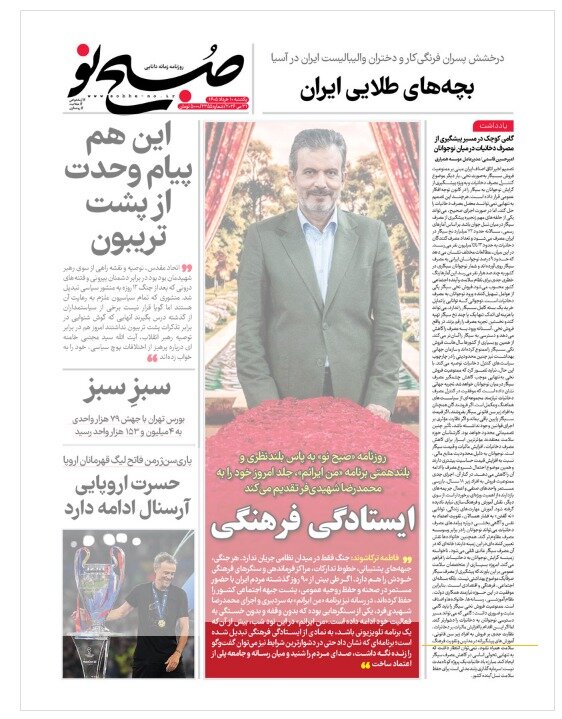
Sobh-e‑No, in its editorial, pointed to Trump’s retreat in the face of a powerful Iran regarding a potential agreement. The framework that can be outlined for an Iran–US agreement includes: Iran’s approval of passage through the Strait of Hormuz under a new management structure that did not exist before the war; Iran’s commitment not to build nuclear weapons—a commitment that already existed before the war; the lifting of oil sanctions; and the release of frozen assets, which together constitute a major strategic gain for Iran.
Now, Axios, quoting American officials, has reported regarding the agreement that: “We have received verbal assurances from Iran about nuclear materials and, more importantly, about what was agreed upon in the negotiations.” A government that entered the war with promises of regime change in Iran and the destruction of its nuclear program has now settled for a verbal pledge about nuclear materials. This unprecedented retreat stands as evidence of Iran’s resilience, deterrence, and initiative—both on the battlefield and at the negotiating table.
Resalat: Diplomacy is a tool for imposing the will of the Iranian nation on the enemy
Resalat defined Iran’s style of diplomacy with the United States. It wrote: Relations between Iran and the United States are miles away from the warm, positive, and traditional meaning of diplomacy. Our diplomacy with America is nothing but the concrete and precise translation of the ‘battlefield.’ When our diplomats speak, they are in fact converting the power of ballistic missiles, the precision‑strike drones of the IRGC and the Army, and the authority of the country’s air defense into political propositions. These diplomatic words and positions merely serve to clarify how the other side must behave in the face of Iran’s power and greatness—and to make clear the heavy price of any miscalculation. In this definition, diplomacy is a tool for imposing the will of the Iranian nation on the enemy, not a path toward compromise.
Siasat‑e-Rooz: Americans failed to build an accurate copy of the Shahed‑136
Siasat‑e-Rooz wrote about the poor quality of the American copy of the Shahed‑136 drone, stating: One of the world’s most prominent drones is Iran’s Shahed‑136, which—with its simple, inexpensive, and efficient design—has attracted the attention of many global powers and sparked a wave of imitation efforts in various countries. The United States was among the first to attempt to develop a version similar to the Shahed‑136. But the range and accuracy of the American models are far lower than the Iranian original. High production costs and design complexity have reduced the feasibility of mass production. In recent operations involving encounters with Iranian drones, the American versions have performed poorly. In fact, the weakness of the American model has forced US military analysts to reassess their drone design and strategy—demonstrating that even major powers with advanced technology can be defeated by a simple and efficient design.
Arman‑e-Melli: Improving economic conditions through a good agreement
Arman‑e-Melli interviewed reformist political activist Mehdi Ayati about what constitutes a good agreement. According to him, a proper negotiation environment enables a win‑win agreement. As long as the enemy seeks to impose itself on us and says, “I will sign an agreement with you only if you surrender,” such a thing is impossible—and the recent war has shown the extent of our capacity to resist. As a result of the resistance, we have reached a stage where the enemy has now accepted the idea of signing an equal agreement with us. Such an equal agreement means compensation for damages and the opening of Iran’s economic space and international economic activity. This is precisely what must result from precise and proper governance by the country’s officials—and nothing less should be accepted.
Arman‑e-Emrooz: The sound of an agreement grows louder
A potential Iran–US agreement could have positive effects on energy markets, maritime security, and even international relations. Analysts believe that Pakistan’s mediation—due to its unique geopolitical position—has created a rare opportunity. Islamabad, by maintaining balanced relations with both Tehran and Washington, has managed to gain the relative trust of both sides. Inside Iran, the news has sparked mixed reactions. Some analysts see it as a step forward toward reducing sanctions and improving economic conditions, while critics emphasize the need to preserve red lines. In the United States, Republicans close to Trump view this approach as a sign of the president’s bargaining strength, whereas Democrats call for greater transparency and consultation with Congress. Despite all this, the path ahead remains full of uncertainty. Trump’s need for a few days of reflection provides an opportunity for consultation with experts, risk assessment, and perhaps coordination with allies.
Leave a Comment